How to Write a Resume Recruiters Actually Notice
A resume is not a biography. It is a decision document. A recruiter opens it with one question in mind: does this person look relevant enough to move forward?
Quick answer: to make a resume noticeable, match it to the role, put the strongest proof near the top, describe achievements with context and outcomes, use the language of the job description naturally, and keep the layout easy to scan in less than a minute.
What recruiters notice first
Most recruiters do not begin by reading every sentence. They scan for role fit, seniority, recent experience, recognizable skills, location or work eligibility when relevant, and evidence that your background matches the vacancy. This does not mean your resume must be flashy. In fact, flashy design can make the important information harder to find.
The first screen should answer three questions: what do you do, what level are you, and why are you credible for this role? A clear headline, a focused summary, and recent experience with measurable evidence usually do more than a long objective statement.
Start with the vacancy, not with yourself
A common mistake is writing one universal resume and sending it everywhere. The stronger approach is to create a solid master resume, then adapt the visible emphasis for each role. Read the vacancy and mark the repeated requirements, tools, responsibilities, and outcomes. Then ask: where does my experience prove these things?
If the job asks for customer success onboarding, do not bury onboarding under a generic line like managed clients. Say that you onboarded new clients, improved activation, created support materials, or reduced repeated questions if that is true. Recruiters notice alignment because it reduces uncertainty.
Write a summary that earns its space
A resume summary is useful only when it clarifies your fit. Avoid broad phrases such as motivated professional, fast learner, or team player. They are not wrong, but they rarely help a recruiter make a decision.
Use two to four lines that combine your role, domain, strongest skills, and proof. For example: Product marketer with 5 years of experience in B2B SaaS, specializing in positioning, launch planning, and sales enablement. Led three product launches and helped increase demo conversion through clearer messaging and segmented collateral.
This kind of summary is specific. It names the function, market, skills, and outcome. It also gives the recruiter language they can repeat to a hiring manager.
Turn duties into evidence
Recruiters see many resumes that list responsibilities: responsible for reports, worked with clients, participated in projects. Responsibilities show what you were assigned. Evidence shows what changed because you were there.
Use a simple formula: action, context, outcome. Instead of wrote newsletters, try created weekly email campaigns for a 40,000-subscriber list, improving click-through rates by testing subject lines and segmenting content. If you cannot share exact numbers, use scale, frequency, complexity, or qualitative outcome: supported enterprise clients across three regions, reduced repeated onboarding questions by creating a shared knowledge base, or coordinated hiring for technical roles during a period of rapid team growth.
Use keywords naturally
Keywords matter because recruiters and applicant tracking systems often search for specific skills, tools, job titles, certifications, and domains. But keyword stuffing makes a resume feel artificial. The goal is not to hide a word cloud in the document. The goal is to describe your real experience using the vocabulary of the role.
Create a skills section with clear groups if you have many tools: analytics, project management, design, programming, languages, methods. Then reinforce the most important keywords inside experience bullets, where they have context. A skill listed once is a signal. A skill connected to an outcome is stronger proof.
Make the layout calm and readable
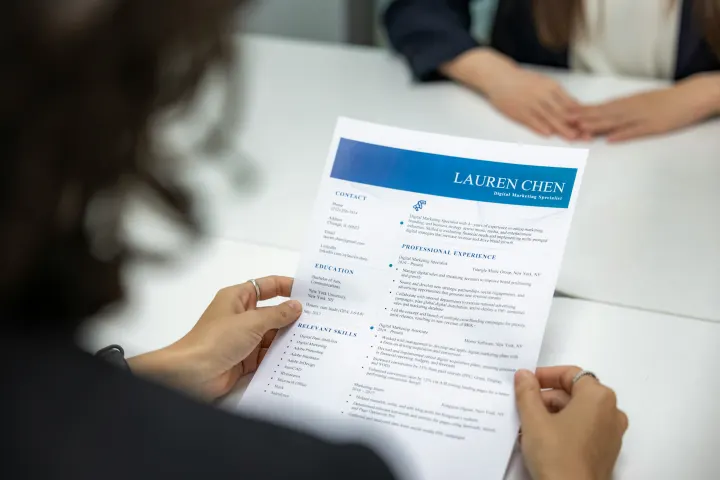
A noticeable resume is often a quiet resume. Use clear headings, consistent spacing, readable fonts, and predictable sections. Avoid tiny text, dense paragraphs, decorative icons, complicated columns, and graphics that may not parse well. Unless you work in a field where a visual portfolio is expected, the resume should serve the reader before it serves personal branding.
One or two pages is usually enough for many professionals, though senior, academic, medical, or technical CVs may need more. The right length is the shortest document that proves fit without hiding important evidence.
What to include near the top
- Name and contact details: email, phone if appropriate, location or work preference, and relevant portfolio or LinkedIn link.
- Professional headline: a clear role label such as UX Researcher, Operations Manager, Junior Data Analyst, or Customer Support Lead.
- Targeted summary: a short fit statement with proof, not personality adjectives.
- Core skills: only skills you can defend in conversation.
- Recent experience: the most relevant roles with achievement-focused bullets.
Before and after example
Weak: Responsible for social media and content creation.
Stronger: Planned and published LinkedIn and Instagram content for a B2B consulting brand, growing qualified inbound inquiries by testing expert-led posts, client FAQs, and case-study snippets.
The stronger version is not longer for the sake of length. It tells the recruiter the channel, audience, business purpose, and type of work.
A quick recruiter-readiness check
- Can a stranger understand your target role in 10 seconds?
- Does the top third of the resume match the vacancy?
- Do your bullets show outcomes, scale, or complexity?
- Are the most important job-description keywords present naturally?
- Would every claim survive an interview question?
- Is the file readable as a PDF and, when requested, in the required format?
Common mistakes that make resumes disappear
The biggest resume mistakes are usually not dramatic. They are small friction points: unclear target role, too many unrelated details, vague achievements, missing dates, unexplained gaps, inconsistent formatting, or a file name like final_resume_new2.pdf. Each creates a tiny question. Too many questions make the recruiter move on.
Another mistake is over-optimizing for templates. A beautiful template cannot fix weak evidence. A plain document with precise experience often performs better than a designed document that hides the answer.
Final thought
A resume gets noticed when it respects the recruiter’s attention. It does not need to shout. It needs to make the match easy to see, the evidence easy to trust, and the next step easy to justify.